Plates and Registration for a Towable Food Trailer: What Applies in 2026
The process isn't the same for every towable. A brand-new food trailer with EU Type Approval and an EU Certificate of Conformity needs to be clearly distinguished from older vehicles that were previously registered under a Special Towing Permit (ΕΣΡ).
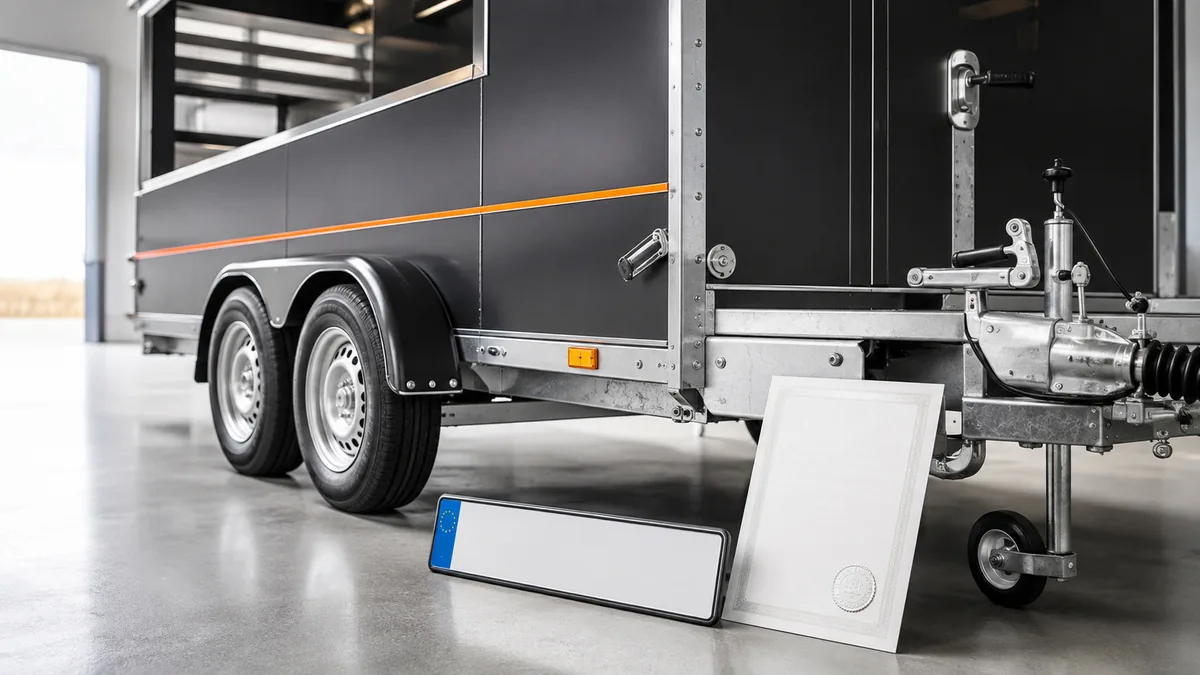
An important clarification: the €200 fee and the special technical inspection you may see mentioned in Regional Authority announcements relate to a specific procedure for older towables that carry a Special Towing Permit (ΕΣΡ), provided the relevant conditions are met. They should not be presented as a blanket rule that applies to every brand-new food trailer with European Type Approval and a Certificate of Conformity.
1. Why the vehicle's history changes the process
The term "towable food trailer" covers vehicles with very different histories, technical characteristics and available documents. A brand-new food trailer with European approval is not automatically treated the same as an old trailer that had been circulating for years under a Special Towing Permit, or as a vehicle that lacks the same documentation.
The competent Transport Department examines the category, the chassis number, the history and the actual documents of that specific vehicle. So whenever someone presents a fixed fee or a specific inspection as "mandatory for every food trailer," they're overlooking real differences between the cases.
| Case | What's mainly checked | What should not be assumed |
|---|---|---|
| New food trailer with European documents | Type Approval, EU Certificate of Conformity, vehicle details and purchase documents. | That the special procedure for an old ΕΣΡ automatically applies. |
| Older vehicle with a Special Towing Permit | Whether the conditions of the special procedure are met for that specific vehicle. | That the old vehicle's rules apply to every new trailer. |
| Any other unusual or uncertain case | Origin, history, documents and any extra requirements from the authority. | That a general description can replace a check by the Transport Department. |
2. What to check on a brand-new food trailer
For a brand-new towable, the right starting point is to ask the supplier for the complete file for that specific vehicle. New e-kantina food trailers come with EU Type Approval and an EU Certificate of Conformity, which relate to the vehicle's lawful identification and approval.
Depending on the case, the competent authority may ask for items such as:
- The EU Certificate of Conformity, also known as the CoC.
- The chassis number and technical details matching the actual vehicle.
- Proof of purchase and the buyer's or business's details.
- Proof of origin or other supporting documents, where required for the specific case.
- The lawful fees or procedural documents confirmed by the competent Transport Department.
It isn't safe to generalize the exact list without looking at the vehicle, its category and its actual origin. If anything is out of the ordinary, confirm the requirements in good time with your local Transport Department.
3. What EU Type Approval and the EU Certificate of Conformity are
European Type Approval concerns approval of the corresponding vehicle type under the applicable European framework. The EU Certificate of Conformity (CoC) accompanies the specific vehicle and documents that it matches the approved type.
Regulation (EU) 2018/858 sets out the vehicle approval system and the certificate of conformity, including the move to an electronic version of the process. What matters for the buyer is that the correct documents exist for that specific trailer and that specific chassis number.
The process by which a manufacturer or authorized body obtains Type Approval should not be confused with registering an already-approved, finished vehicle in the end customer's name. These are different procedures involving different parties and different documents.
4. When do the €200 fee and the special technical inspection relate to an ΕΣΡ?
Announcements from Regional Authorities that refer to a €200 fee and a special technical-inspection procedure concern specific cases of older Ο1/Ο2 category towables that were circulating under a Special Towing Permit (ΕΣΡ), provided they fall under the relevant provisions.
The key difference is the vehicle's actual history. An older towable that falls under the special procedure may have different requirements from a brand-new food trailer that already comes with Type Approval and a CoC.
In short: it isn't correct to state that every new food trailer automatically pays a €200 fee, or that every new trailer follows the special ΚΤΕΟ procedure for old ΕΣΡ vehicles. If a technical inspection, a fee or some other document is required for a specific vehicle, that is confirmed by the competent authority.
5. Practical steps before plates are issued
- Ask for the vehicle's file: confirm that the documents actually relate to the towable you're buying.
- Check the chassis number and technical details: the figures must match across the relevant documents.
- Contact the Transport Department: ask for the list of documents required for your vehicle's exact category and history.
- Clarify whether a special case applies: an old ΕΣΡ, missing documents or another unusual circumstance needs a separate assessment.
- Don't assume general rules in advance: apply the fees and checks that genuinely correspond to your own case.
If you're comparing several models, also read what to check before buying a towable food trailer. It's important to check the certificates before you buy, not after delivery has already been agreed.
6. Plates don't replace an operating licence
The vehicle's registration and plates relate to the vehicle itself. Running a food trailer that serves food or drinks is a separate matter that depends on the location, the activity, health-and-safety requirements and the procedure set out by the competent municipality and other authorities.
For example, a coffee food trailer, a street food trailer and an ice cream food trailer can have different practical equipment and hygiene needs, even though the towable itself carries the same registration documents.
See our complete guide to licensing a mobile food trailer (based on Greek regulations). The official OpenBusiness portal clarifies that the process differs depending on the location, and that a transitional submission method applies in certain cases until the proper digital form is supported.
What to ask before buying
- Does this specific vehicle have EU Type Approval and an EU Certificate of Conformity?
- Do the documents match the actual chassis number?
- Is it a brand-new approved vehicle, or an older towable under an ΕΣΡ?
- Which documents does the competent Transport Department ask for in this specific case?
- Has the food-business operating procedure been checked separately?
Looking for a brand-new, approved food trailer?
e-kantina models come with EU Type Approval and an EU Certificate of Conformity. Get in touch for the available dimensions and specifications of the model you're interested in.
Official sources and clarifications
This article is for informational purposes only and does not constitute legal or technical advice. The documents, fees and any inspections required are determined case by case by the competent Transport Department and other relevant authorities.